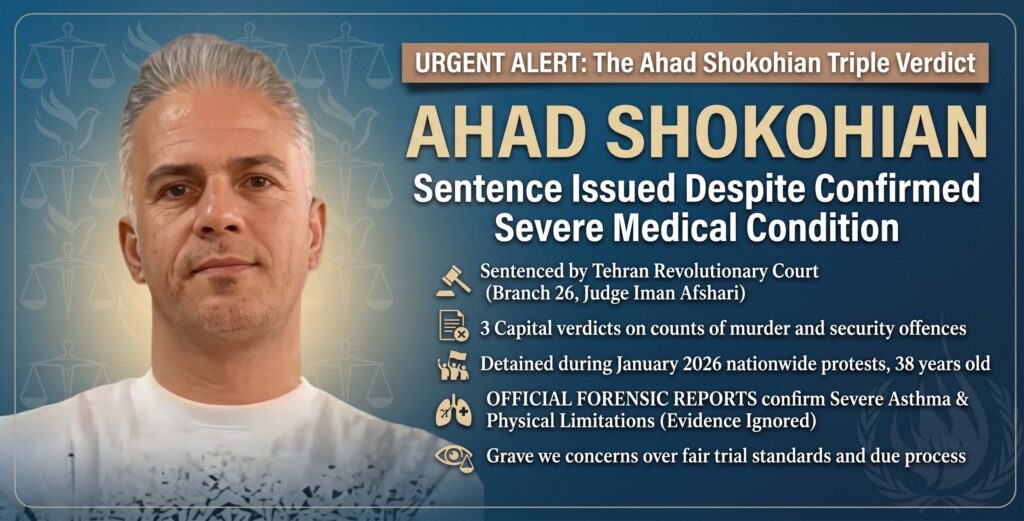
Ahad Shokohian, a 38-year-old man arrested during Iran’s January 2026 nationwide protests, has been condemned to death three times. The harsh verdict was delivered by Judge Iman Afshari of Branch 26 of the Tehran Revolutionary Court. Strikingly, the ruling comes despite official medical examiner reports confirming that Shokohian suffers from severe asthma—a condition that drastically limits his physical capabilities.
Arrest and Serious Allegations Detained on January 15, 2026, in Pakdasht, Tehran, Shokohian is listed as the third defendant in a sweeping, multi-defendant security case. The Iranian authorities have leveled heavy charges against him, including “participation in two counts of intentional murder,” “acting against national security,” “assembly and collusion against national security,” and “destruction of public property.”
In mid-June 2026, Shokohian was transferred to Ghezel Hesar Prison in Karaj, where he is currently being held. This facility is heavily utilized for security detainees and death-row inmates, and has recently been the center of numerous human rights alerts regarding hunger strikes, executions, and deteriorating living conditions.
Ignored Medical Evidence and Legal Ambiguities A glaring contradiction in Shokohian’s case involves his physical health. The charges against him imply active, strenuous physical participation in the alleged crimes. However, forensic medical experts have officially documented his severe asthma, raising serious doubts about his physical capacity to commit the acts he is accused of.
Despite this critical evidence, the court’s rationale remains hidden. Judicial authorities have not publicly explained how they weighed or dismissed the medical examiner’s findings when handing down a triple capital punishment verdict.
Grave Concerns Over Due Process The extreme severity of this sentence has sparked outrage among human rights defenders, who point to a continuing pattern of opaque trials for protesters. Activists emphasize that capital cases require strict adherence to fair trial guarantees, yet these proceedings seemingly bypass basic legal safeguards.
The trial raises significant questions regarding compliance with both domestic and international law:
- Domestic Law Violations: The case highlights potential violations of key Iranian Constitutional protections, including the prohibition of arbitrary detention (Article 32), the fundamental right to legal counsel (Article 35), and the presumption of innocence (Article 37).
- International Human Rights Breaches: The verdict contradicts fundamental global standards, notably the Universal Declaration of Human Rights (UDHR) and the International Covenant on Civil and Political Rights (ICCPR), which strictly protect the inherent right to life and mandate fair, impartial trials.
Imposing the death penalty under such ambiguous circumstances—where vital medical evidence is marginalized and defense rights are questionable—continues to draw severe international condemnation. Human rights organizations are urgently demanding transparency and strict compliance with legal safeguards to prevent wrongful executions.
Key Information | Ahad Shokohian
- Name: Ahad Shokohian
- Age: 38 years old
- Arrest Date: January 15, 2026
- Arrest Location: Pakdasht, Tehran
- Detention Facility: Ghezel Hesar Prison, Karaj
- Court: Branch 26, Tehran Revolutionary Court (Presiding Judge: Iman Afshari)
- Sentence: Sentenced to execution three times
- Medical Condition: Diagnosed with severe asthma