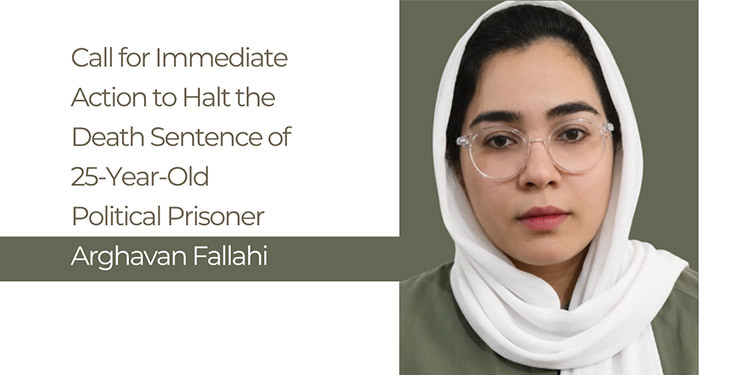
Iranian political prisoner Arghavan Fallahi has been sentenced to death on a charge of baghi, or “armed rebellion.” Human rights organizations say her detention involved prolonged solitary confinement, restricted access to legal counsel, and alleged abuse, prompting urgent appeals to prevent her execution.
Iranian political prisoner Arghavan Fallahi, currently held in Tehran’s Evin Prison, has been sentenced to death by Branch 15 of the Tehran Revolutionary Court. The court, presided over by Judge Abolghasem Salavati, convicted her under Article 287 of Iran’s Islamic Penal Code on the charge of baghi, commonly translated as “armed rebellion.”
The ruling has triggered growing concern among human rights organizations, which are calling for urgent international action to prevent the sentence from being carried out. IranWire reported that the verdict is preliminary and can be appealed before Iran’s Supreme Court.
Months of Detention and Solitary Confinement
According to the NCRI Women’s Committee, Fallahi was detained in January 2025 and spent approximately five months in solitary confinement in Ward 241 of Evin Prison. The organization alleges that she was subjected to intense interrogation and physical and psychological abuse during her detention.
Other human rights organizations have reported similar concerns. HRANA said Fallahi was held in Wards 209 and 241 of Evin Prison and cited an informed source alleging severe psychological pressure and attempts to obtain forced confessions. Hengaw has separately reported allegations of both physical and psychological abuse while she was in custody.
The exact details of her arrest date and age vary slightly among reporting organizations. The NCRI Women’s Committee identifies her as 25 and gives January 25, 2025, as her arrest date, while HRANA and IranWire have described her as 24.
What Is Arghavan Fallahi Accused Of?
According to HRANA and IranWire, the Revolutionary Court convicted Fallahi of baghi based on allegations that she was connected to opposition groups and participated in armed activities. Human rights organizations say she has denied the accusations and have raised concerns about restrictions on her access to legal representation and the closed nature of the proceedings.
Rights groups also reported that security authorities attempted to connect her to the killings of judges Mohammad Moghiseh and Ali Razini and sought confessions from her during interrogation. These claims concerning interrogation methods and alleged mistreatment come from human rights organizations and have not been independently verified in publicly available judicial records.
A Previous Arrest During the 2022 Protests
This was not Fallahi’s first encounter with Iran’s security and judicial system. She was previously arrested alongside her father in November 2022, during the nationwide “Woman, Life, Freedom” protests.
HRANA reports that she was later sentenced to two years in prison on charges including “assembly and collusion” and “propaganda against the state.” She was eventually released after serving that sentence. The NCRI Women’s Committee says her father, Nasrollah Fallahi, remains imprisoned in Evin Prison.
Human Rights Groups Warn of an Irreversible Outcome
The death sentence has generated alarm because execution is an irreversible punishment, while questions remain about the evidence, interrogation process, access to counsel, and fairness of the proceedings.
Human rights advocates argue that no death sentence should be carried out when serious questions remain about whether a defendant received a fair and transparent trial. The NCRI Women’s Committee has called on the United Nations, member states, and international human rights organizations to intervene and press for Fallahi’s death sentence to be overturned.
The organization has also called for international human rights monitors, including relevant United Nations mechanisms, to be granted access to Iranian prisons and political detainees.
A Young Woman Facing the Ultimate Punishment
Behind the legal terminology, political accusations, and court documents is the life of a young Iranian woman now facing the possibility of execution.
Fallahi’s case has become another focal point in the wider debate over Iran’s use of capital punishment in cases involving political prisoners and alleged opposition activity. Human rights organizations have repeatedly expressed concern over the use of charges such as baghi and moharebeh in cases that can result in death sentences.
For those campaigning on her behalf, the urgency is clear: a death sentence leaves no possibility of correcting an injustice once it has been carried out.
As Fallahi’s case moves through the judicial process, rights advocates are urging the international community to keep attention on her fate and press for a transparent review of the evidence, full access to legal representation, and protection of her fundamental rights.