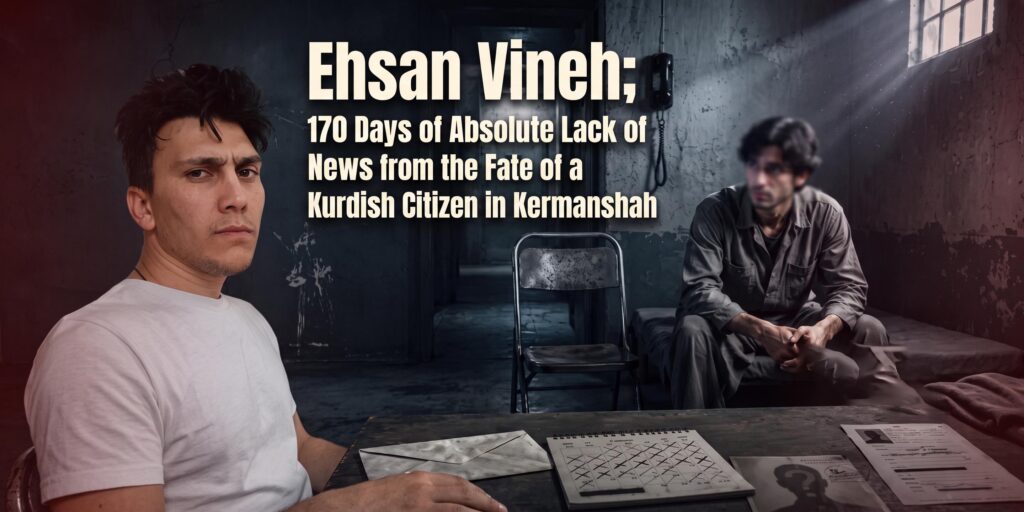
With the passage of more than 170 days from the arrest of Ehsan Vineh, a 29-year-old citizen from Kermanshah, his family still has no information about his place of detention, physical condition, charges, and fate. Complete deprivation of contact, visit, and access to a lawyer has increased concerns about the possibility of enforced disappearance and widespread violation of his legal rights.
Iran Human Rights Society, Monday, June 22, 2026 – Ehsan Vineh, a 29-year-old Kurdish citizen from Kermanshah, has been in the detention of security forces for more than 170 days, without his family having received even a short contact from him. Reports indicate that Ehsan Vineh was arrested on Sunday, January 4, 2026, in the Jafarabad neighborhood of Kermanshah by security forces and transferred to an unknown location. Since then, neither his place of detention has been determined, nor have any possible charges against him been announced, nor has access to a lawyer or visit with family been provided for him. This situation has created serious concerns about the health, life safety, and legal rights of Ehsan Vineh and has once again placed the issue of long-term detentions accompanied by absolute lack of news in the focus of human rights activists’ attention.

How was Ehsan Vineh arrested?
Based on published reports, Ehsan Vineh was arrested on Sunday, January 4, 2026, in the Jafarabad neighborhood of Kermanshah by security forces. Informed sources have stated that the agents did not present any judicial warrant at the time of arrest and immediately transferred him to an unknown location after the arrest.
Since the time of arrest, no official information about the place of detention of Ehsan Vineh has been published. His family has referred to security institutions, detention centers, prisons, and judicial authorities many times in the past months, but none of these institutions have accepted responsibility for his detention or provided information about his condition.
Arrest without presenting a judicial warrant and failure to announce the place of detention had increased serious concerns about the condition of this Kurdish citizen from the first days; concerns that still continue with the passage of more than five months.
Why has the lack of news from the fate of Ehsan Vineh increased concerns?
The most important part of this case is the complete lack of news from the condition of Ehsan Vineh. According to sources close to the family, he has not had even a few-second contact with his family during more than 170 days of detention.
One informed source has said that Ehsan Vineh’s family today does not even know if he is alive or not. This situation continues while all the family’s follow-ups to obtain information about his fate have remained fruitless.
Human rights activists emphasize that depriving a detainee of any contact with family for such a long period not only puts severe pressure on the person himself but also puts the family in a state of uncertainty and permanent anxiety.
Ehsan Vineh is married and has two children, and the continuation of this situation has increased the concerns of his family and relatives more than before.
Have Ehsan Vineh’s charges been determined?
Despite the passage of more than five months from the arrest of Ehsan Vineh, no official information about the reasons for the arrest or the charges attributed to him has been published so far.
Ehsan Vineh’s family and close associates say that no official authority has provided an explanation about his case and it is not clear on what basis his arrest was carried out.
The lack of any information about the charges, along with complete deprivation of access to a lawyer, has caused the process of handling this case to be placed in a halo of ambiguity.
Lawyers emphasize that informing the accused of the charges against him and the possibility of defending himself are among the most basic principles of fair trial, and failure to observe these rights can cast serious doubt on the legitimacy of the judicial process.
Can Ehsan Vineh’s condition be considered an example of enforced disappearance?
Human rights activists believe that the conditions of Ehsan Vineh’s case possess many of the characteristics that are recognized in international documents as “enforced disappearance.”
In this case, the individual was arrested by government forces, his place of detention has not been announced, the family has been deprived of any communication with him, and the responsible institutions have also refused to provide information.
Such a situation effectively places the individual outside the protection of the law and increases the danger of violating his fundamental rights. Human rights institutions have repeatedly warned that holding individuals in conditions of absolute lack of news increases the possibility of torture, mistreatment, and forced confession.
For this reason, Ehsan Vineh’s case from the perspective of many human rights observers is considered beyond an ordinary arrest and has been noticed as a worrying example of arrest accompanied by absolute lack of news.
What problems is Ehsan Vineh’s family facing?
Ehsan Vineh’s family has referred to various institutions many times in the past months to obtain information about his condition. However, all these referrals have remained without result.
According to those close to the family, the common response of various institutions has been that “we have no information.” This is while Ehsan Vineh’s arrest was carried out by security forces and the family expects to at least be informed about his place of detention and health condition.
Long-term uncertainty and the lack of any news from the detainee’s condition have imposed heavy psychological pressure on the family. This concern has found wider dimensions especially for Ehsan Vineh’s wife and two children, and they have been waiting for months to receive the smallest news about his condition.
Legal examination of the case based on domestic laws
Legal ambiguities of the case
The most important ambiguity of Ehsan Vineh’s case is arrest without presenting a judicial warrant and the continuation of complete lack of news from his condition. Also, after the passage of more than 170 days, the possible charges against him have still not been announced and there is no official information about the judicial handling process.
Lack of access to a lawyer, deprivation of contact with family, and the unknown place of detention are also among other important ambiguities of this case.