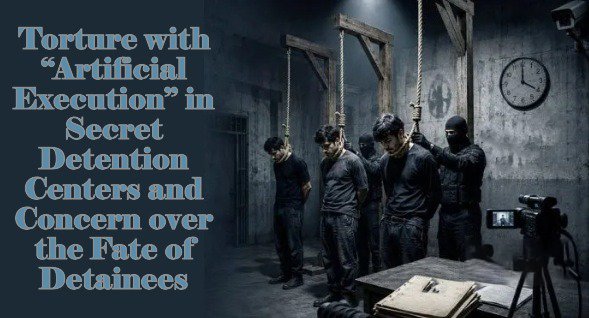
The account of one of the detainees from the nationwide protests of December 2025 – January 2026 of severe physical and psychological tortures, repeated implementation of “artificial execution” and efforts to extract forced confessions, has once again drawn attention to the situation of secret and unofficial detention centers. Human rights institutions have called for independent investigation into these reports and accountability of officials.
ran Human Rights Society, Saturday, June 27, 2026 – Simultaneously with the publication of new accounts from detainees of the nationwide protests of December 2025 – January 2026, one of the young people who was arrested during the protests in Hamadan, in a report sent to the Iran Human Rights Society, has reported severe tortures, repeated implementation of “artificial execution” and efforts to force detainees to make forced confessions. This account has increased concerns about what is happening to detainees in unofficial detention centers outside public oversight and has once again placed the absolute prohibition of torture at the center of attention.
What account has the detainee from the nationwide protests presented of his detention period?
his young person who was arrested in the nationwide protests of December 2025 – January 2026 in Hamadan says that after arrest along with a number of other detainees, he was transferred to a place whose exact location was not clear to them and it is still not known under the control of which institution this detention center was administered.
He has written in his report that the detainees were continuously subjected to beatings and torture and were deprived of minimum basic necessities of life, including adequate food, hygiene and humane conditions of detention. According to him, the intensity of physical and psychological pressures was to such an extent that many individuals, to put an end to the tortures, were ready to express any content that the interrogators wanted against themselves.
How had artificial execution turned into a tool for torturing detainees?
The shocking part of this account relates to what is called in international law “artificial execution” or Mock Execution.
This detainee says that the agents every day around four o’clock in the morning would transfer a group of prisoners to an area where several gallows had been set up. With threats and mockery, they would create the impression that the time for execution of the sentence had arrived.
He writes:
“They would put the rope around our necks and say ‘Do you want to change the regime?’ Then they would lift us off the ground for a few seconds and bring us down again.”
Human rights experts emphasize that artificial execution is considered one of the most severe forms of psychological torture, because it puts the individual in a situation where he is certain that he has reached the threshold of death. The effects of this type of torture can remain for years and cause serious psychological damages, chronic anxiety, depression and post-traumatic stress disorder.
What has been the purpose of applying these tortures?
Based on the account of this detainee, the main purpose of the tortures has been breaking the resistance of the protesters and obtaining confessions that could later be used in the judicial process and courts.
In past years as well, numerous reports have been published by human rights institutions about extracting forced confessions from detainees of protests. Lawyers emphasize that any admission or confession obtained under torture, threat or psychological pressure lacks legal validity and should not be the basis for issuing a verdict.
Why are unofficial detention centers still a source of concern?
The account of this young person once again raises serious questions about the situation of unofficial detention centers and centers where the place of detention of many detainees is not officially announced.
Due to the lack of access of lawyers, families and independent institutions to these centers, the possibility of independent examination of the detention conditions of detainees is very limited. This very issue has caused concerns about the possibility of occurrence of torture, inhumane behaviors and other cases of human rights violations to increase.
Human rights institutions have repeatedly called for clarification about the place of detention of detainees, the possibility of meeting with family, access to a lawyer and conducting independent investigations into torture claims.
Why should the global community not ignore human rights violations in its agreements?
The continuation of reports related to torture, forced confessions and inhumane behaviors against detainees of nationwide protests highlights the responsibility of the global community towards the human rights situation. Governments that enter into any negotiation, agreement or political and economic cooperation with the Iranian regime should not marginalize the issue of human rights, but it is necessary to place the cessation of torture, ending the implementation of execution sentences, release of political prisoners and guaranteeing fair trials at the top of their demands. Ignoring these cases and normalizing relations without demanding accountability for serious human rights violations can lead to weakening international efforts to support victims and reducing pressure for compliance with human rights obligations.
Examination of the legal case based on domestic laws
Legal ambiguities of the case
In this case, there are numerous ambiguities about the legality of the place of detention of detainees, the manner of interrogation, observance of the rights of the accused, their access to a lawyer and the possible use of confessions obtained under pressure.
Related legal articles
Principle 32 of the Constitution
The arrest of individuals must be in accordance with the law, accompanied by immediate notification of the charge and observance of legal formalities.
Principle 38 of the Constitution
Any torture for obtaining confession or gaining information is prohibited and confession obtained by force has no legal validity.
Principle 39 of the Constitution
Violating the dignity and humiliating behavior towards detainees is prohibited.
Criminal Procedure Law
It guarantees the right of the accused to access a lawyer and observance of defense rights.
Cases of violation of the law
Applying physical and psychological torture against detainees
Using confessions obtained under torture
Detaining individuals in unknown detention centers or outside public oversight
Deprivation of access to lawyer and family
Violation of legal formalities of arrest and interrogation
Why can this case be an example of human rights violation?
In case of the accuracy of the published accounts, the described actions are in conflict with the fundamental principles of human rights and the absolute prohibition of torture. Artificial execution, threat of death, beatings and forcing to confess are among the behaviors that in international documents are recognized as examples of torture and inhumane behavior.