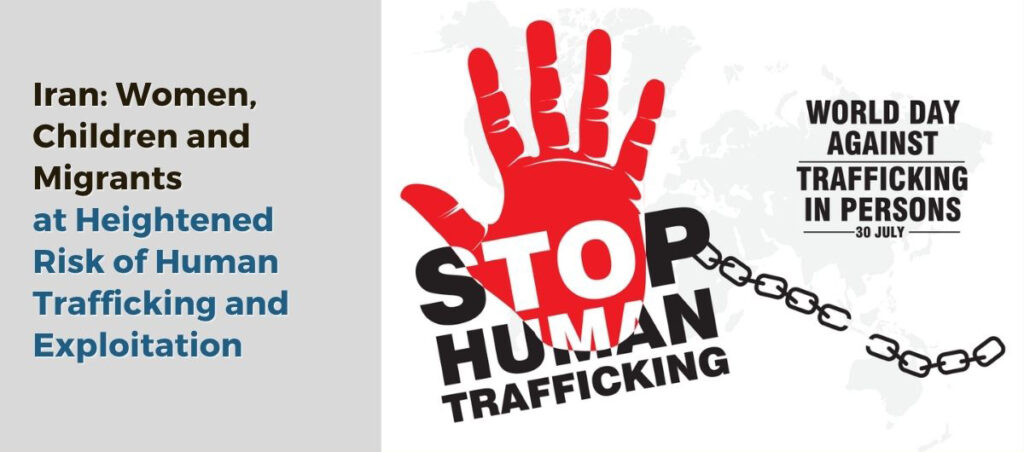
Poverty, gender discrimination, child labor, irregular migration and weak protection systems are leaving some of Iran’s most vulnerable communities increasingly exposed to trafficking, forced labor and other forms of exploitation. Women and girls, children, and undocumented Afghan migrants face particularly serious risks.
Human trafficking rarely begins with chains or visible force. For many victims, it begins with a promise — a job, an education, a marriage opportunity, a safer place to live, or the hope of a better future.
In Iran, economic hardship, social inequality, migration insecurity and limited victim-protection mechanisms are creating conditions in which traffickers and exploitative employers can prey on people who have few alternatives.
A report published by Iran Human Rights Monitor ahead of World Day Against Trafficking in Persons 2026 warns that women and girls, vulnerable children, and migrants — particularly undocumented Afghans — face heightened risks of trafficking and exploitation. Reliable nationwide figures remain difficult to establish because comprehensive official data are not regularly published.
A Global Crisis That Is Getting Worse
Human trafficking is one of the most serious forms of organized exploitation.
Under the international definition established by the Palermo Protocol, trafficking can involve recruiting, transporting, transferring, harboring or receiving people through coercion, deception, abuse of power or exploitation of vulnerability for purposes including sexual exploitation, forced labor, slavery-like practices and servitude. In cases involving children, proof of coercion or deception is not required when recruitment or transfer is carried out for exploitation.
The UN Office on Drugs and Crime reported that the number of detected trafficking victims worldwide in 2022 was around 25% higher than in 2019. Children accounted for roughly 38% of detected victims, while women and girls together represented approximately 61%.
Behind those percentages are individuals whose vulnerability has been turned into profit.
Women and Girls Targeted Through False Promises
Women and girls in economically deprived areas of Iran may be particularly vulnerable to deceptive recruitment.
According to Iran Human Rights Monitor, traffickers may approach potential victims with promises of employment, education, marriage, modeling work, migration opportunities or a better life abroad. After victims are moved or isolated, they may face confiscation of identity documents, restrictions on movement, intimidation, debt, violence, sexual exploitation or forced labor.
The report identifies economic insecurity and gender discrimination as important factors increasing vulnerability. Women heading households, divorced women, girls fleeing violence and women without strong family or institutional support can face particularly dangerous circumstances when an apparently attractive opportunity is offered to them.
What begins as hope can therefore become a trap.
Poverty Can Become a Weapon Against the Vulnerable
Economic hardship does not automatically lead to trafficking, but severe poverty can make people easier to exploit.
A person unable to pay for food, housing or medical care may accept work under conditions they would otherwise reject. Someone desperate to leave an abusive household may trust a stranger offering accommodation or employment. A migrant without legal documentation may tolerate unpaid wages or dangerous working conditions because reporting an employer could expose them to detention or deportation.
Trafficking networks exploit exactly these forms of vulnerability.
Iran Human Rights Monitor says unemployment, domestic violence, discrimination and inadequate social protection can combine to create an environment in which deceptive recruiters and exploitative employers gain power over vulnerable individuals.
Children Exposed to Labor, Begging and Exploitation
Children face another layer of danger.
Across Iran, children can be found working in waste collection, street vending, agriculture, workshops, brick kilns and other informal or hazardous sectors. Child labor itself is not automatically human trafficking. But when children are controlled by intermediaries, coerced, trapped by debt or deliberately exploited because of their vulnerability, the situation may amount to forced labor or trafficking.
Children from impoverished Iranian households and undocumented Afghan families can face especially difficult conditions. Some work long hours in dangerous environments with little meaningful protection from abuse, occupational hazards or exploitation.
Reports have also documented concerns over the illegal sale of newborns and children in Iran. Although reliable national statistics remain unavailable, reported cases have been associated with extreme poverty, addiction, family crises and illicit brokerage networks.
For a child with no financial independence, legal knowledge or safe adult to turn to, escaping exploitation can be extraordinarily difficult.
Afghan Migrants Face Risks Created by Irregular Status
Afghan refugees and migrants form another particularly vulnerable population.
Iran has hosted large Afghan communities for decades, but undocumented migrants often live and work without the protections available to people with secure legal status.
Many work in the informal economy without enforceable contracts or reliable access to legal remedies. Iran Human Rights Monitor reports risks including excessive working hours, withheld wages, hazardous workplaces and threats by employers to report undocumented workers to immigration authorities. Where a worker cannot realistically leave because of coercion, threats, debt or abuse of their immigration status, such conditions may become forced labor.
Women, girls and unaccompanied Afghan children may face additional vulnerabilities, including sexual exploitation and deceptive offers involving employment, marriage or residency.
Fear itself can become a tool of control: report the abuse and risk deportation, or remain silent and continue to be exploited.
Deportation and Instability Can Increase Vulnerability
Migration enforcement and human trafficking are not the same issue, and irregular migration should not automatically be treated as trafficking.
However, sudden displacement, family separation and dependence on smugglers or informal transportation networks can leave migrants more vulnerable to criminal exploitation.
Iran Human Rights Monitor warns that large-scale deportations and inadequate safeguards can increase these risks, particularly when individuals are returned without proper screening to determine whether they may already be victims of trafficking or exploitation.
International standards emphasize that potential trafficking victims should be identified and protected regardless of nationality or immigration status.
Iran Remains in the Lowest U.S. Trafficking Tier
The U.S. State Department’s 2024 Trafficking in Persons Report placed Iran in Tier 3, its lowest category, concluding that the government did not fully meet minimum standards for eliminating trafficking and was not making significant efforts to meet them. The more recent 2025 report also kept Iran in Tier 3.
The assessments have raised concerns about victim identification, protection services, transparency and accountability, including allegations involving official complicity that authorities have not adequately addressed.
Iran adopted an anti-trafficking law in 2004, but rights monitors argue that having legislation is only the beginning. Effective protection also requires shelters, medical and psychological care, legal assistance, victim identification procedures, compensation and long-term rehabilitation.
The Missing Numbers Matter
One of the biggest obstacles to understanding trafficking in Iran is the absence of comprehensive public statistics.
Authorities do not regularly release detailed nationwide figures showing how many trafficking victims have been identified, how many cases have been investigated, how many perpetrators have been convicted, or how many survivors have received rehabilitation and protection services, according to Iran Human Rights Monitor.
Without transparent data, it becomes difficult to measure the true scale of the problem — and equally difficult to determine whether government policies are actually protecting victims.
The people missing from those statistics may be precisely those most in need of protection.
Human Trafficking Is More Than a Crime — It Is an Exploitation of Vulnerability
Trafficking cannot be confronted only by arresting individual traffickers.
The conditions that make exploitation possible must also be addressed.
Poverty gives traffickers leverage. Gender inequality leaves women with fewer options. Child labor exposes minors to abusive networks. Undocumented status can make migrants afraid to seek justice. Weak social protection allows vulnerable people to disappear without anyone noticing.
An effective response therefore requires more than criminal punishment. It requires early identification of victims, safe shelters, legal and medical assistance, psychological support, transparent investigations and protections ensuring that trafficking survivors are not punished for crimes or immigration violations resulting directly from their exploitation.
The central question is simple but urgent:
When a woman, child or migrant asks for help, will the system recognize a victim who needs protection — or treat that person as someone to punish?
Until vulnerable people can seek help without fearing detention, deportation, stigma or retaliation, human trafficking will continue to thrive in the shadows.