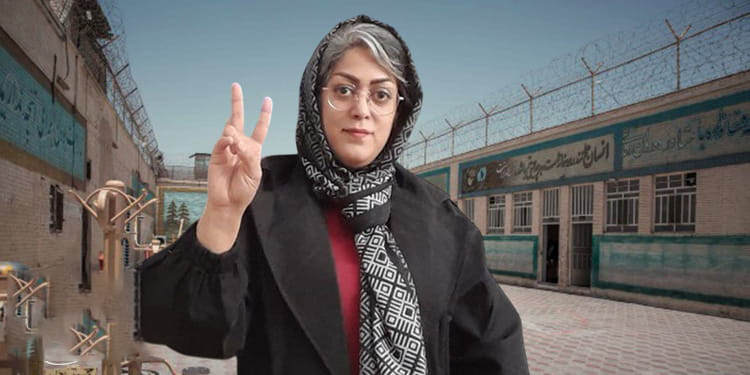
From inside Yazd Central Prison, Iranian political prisoner Parisa Kamali has delivered a defiant audio message condemning executions and repression, declaring that fear can no longer silence those demanding change. Her appeal has renewed attention to the treatment of political prisoners and the continued use of capital punishment in Iran.
From behind the walls of Yazd Central Prison, Parisa Kamali has sent a message that reaches far beyond her cell.
In an audio recording published on August 5, 2026, Kamali condemned Iran’s continued use of executions and what she described as a policy of repression designed to intimidate society. Her central message was unmistakable: “We have moved beyond fear.”
According to the NCRI Women’s Committee, Kamali argued that executions and intimidation have failed to silence public anger and resistance. She also appealed to international organizations and governments not to remain indifferent to executions and alleged human rights violations in Iran.
A Voice From Behind Prison Walls
Kamali’s message described generations of Iranians living with grief, repression, and repeated cycles of violence. Referring to executions stretching back decades, she accused the authorities of using capital punishment as a means of spreading fear and preserving political control.
But she argued that fear itself is losing its power.
For a prisoner speaking from detention, that declaration carries particular weight. Kamali is not commenting from safety outside the country; according to reports about her case, she remains incarcerated in Yazd Central Prison while facing the consequences of several security-related prosecutions.
Her message presents a striking contrast: imprisonment on one side, and an insistence on speaking publicly on the other.
An Appeal to the International Community
Kamali also directed part of her message beyond Iran’s borders.
She called on international institutions and human rights organizations to take practical action against executions and alleged abuses rather than simply observing developments from a distance. She expressed hope for a future Iran in which capital punishment would no longer have a place in the country’s legal system.
Her appeal comes amid continuing concern from rights advocates about Iran’s use of the death penalty and the treatment of political and other prisoners.
For Kamali, the issue is not presented as an abstract legal debate. Her message portrays every execution as part of a broader climate of fear affecting prisoners, their families, and society as a whole.
Who Is Parisa Kamali?
The NCRI Women’s Committee identifies her full name as Parisa Kamali Ardakani. According to the organization, she was arrested in Isfahan on April 29, 2024, and initially transferred to Dowlatabad Prison. She later faced several cases involving security-related accusations in Isfahan and Ardakan.
In 2025, she was transferred from Dowlatabad Prison to Yazd Prison, where she remains detained, according to the same source. The organization says she was born in 1986 in Abadan, is married, and is a geography student.
Her imprisonment has previously drawn attention from human rights groups. In December 2025, HRANA reported that Kamali had begun a hunger strike in Yazd Prison amid a dispute over the consolidation of her sentences.
Concerns Over Her Health in Prison
Kamali’s case has also raised concerns about access to medical treatment.
A July 2026 report by the NCRI Women’s Committee said she suffers from hyperthyroidism and had previously been diagnosed with a thyroid nodule requiring specialist monitoring, testing, and treatment. The organization alleged that this medical care had been interrupted during her imprisonment.
Reports concerning prisoners’ medical treatment are particularly significant because incarceration places detainees entirely under the responsibility of prison authorities for access to doctors, medication, examinations, and emergency care.
For Kamali, the combination of imprisonment, reported health concerns, and continued public statements has made her case increasingly visible among organizations following the treatment of political detainees in Iran.
Speaking Despite the Risks
Public messages from inside prison can carry serious personal consequences for detainees, particularly when they directly criticize state policies.
Yet Kamali has spoken publicly on executions before. In June 2026, the NCRI Women’s Committee reported another audio message in which she condemned a surge in executions and argued that capital punishment would not suppress opposition.
Her August message continues that theme, but its language is especially striking because it centers on the disappearance of fear itself.
Prisons are designed to restrict movement. Solitary confinement can restrict contact. Punishment can discourage speech. But Kamali’s message raises a deeper question: What happens when fear—the very mechanism intended to produce silence—stops working?
More Than the Story of One Prisoner
Parisa Kamali’s message is ultimately about more than one woman’s imprisonment.
It reflects a broader struggle over executions, political dissent, prisoners’ rights, and the limits of repression. Whether one examines the case through the lens of criminal justice, human rights, or political conflict, the fundamental questions remain serious: Are prisoners receiving adequate legal and medical protections? Can criticism be expressed without fear of severe punishment? And what safeguards exist when the state holds complete power over a detainee’s liberty and wellbeing?