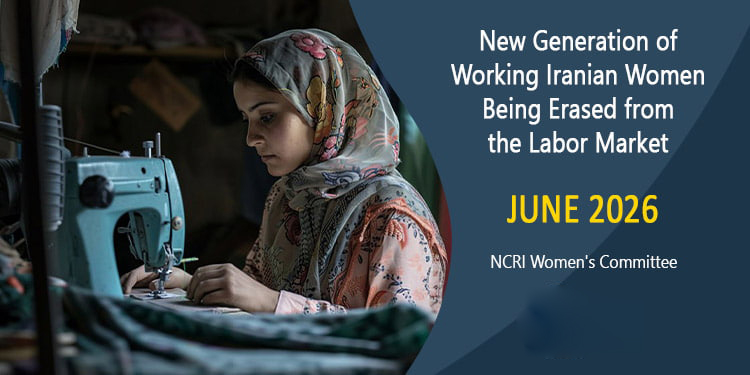
A June 2026 report warns that nearly 195,000 Iranian women have disappeared from employment over the past year, while women’s economic participation has fallen to around 12%. Behind the statistics are educated professionals, mothers, young graduates, and low-income workers struggling against unemployment, shrinking wages, inflation, and an increasingly fragile labor market.
For millions of Iranian women, employment represents far more than a paycheck. It can mean independence, professional identity, financial security, and the ability to shape their own future.
Yet a new report on Iran’s labor market paints a troubling picture: while the country’s working-age population continues to grow, women are increasingly disappearing from formal employment.
According to the June 2026 report by the NCRI Women’s Committee, nearly 195,000 employed women left the labor market over the previous year, even as male employment reportedly increased by about 228,000. At the same time, Iran’s overall economic participation rate fell below 40%, described in the report as its lowest level in a decade.
Nearly 195,000 Women Disappear from Employment
The report says Iran’s working-age population grew by more than 810,000 people, while total employment increased by only around 34,000.
That means only a small fraction of new working-age citizens found their way into employment.
But the gender divide is especially striking. While employment among men reportedly increased, women experienced a sharp decline, with approximately 195,000 fewer women counted among the employed population.
The figures suggest that Iran’s employment crisis is not affecting everyone equally. Women appear to be carrying a particularly heavy share of the economic pressure.
Women’s Economic Participation Falls to Around 12%
Citing economist Zahra Karimi of the University of Mazandaran, the report says the economic participation rate among Iranian women has fallen to approximately 12%, following a sharp decline over the previous year.
But a falling unemployment rate does not necessarily mean more women are finding jobs.
Instead, many women who lose employment may stop actively searching for work altogether. Once they are no longer classified as job seekers, they can disappear from unemployment statistics and instead be counted as economically inactive.
According to the report, while the number of women actively seeking work increased only slightly, close to 190,000 women exited the labor market entirely.
Behind that statistical change are thousands of women whose careers, income, and hopes for financial independence may have been interrupted.
Internet Restrictions Hit Women’s Jobs Hard
The economic damage has also extended into Iran’s digital economy.
Online businesses, home-based enterprises, digital services, and social-media-driven commerce have become important sources of income for many Iranian women who face barriers to traditional employment.
The report says periods of severe internet restrictions have damaged these livelihoods, particularly within the service sector. Female employment in services reportedly declined by more than 65,000, while approximately 109,000 women were lost from employment in industrial and manufacturing sectors amid broader economic difficulties.
For women who built businesses through online platforms, losing internet access can mean losing customers, income, and years of work almost overnight.
Educated Women Face a Closed Door
Perhaps one of the most painful aspects of the employment crisis is its impact on educated young women.
The report says unemployment among young Iranian women has reached 32.2%, while higher-education graduates account for 63.5% of unemployed women.
These figures reveal a striking contradiction.
Women study, earn university degrees, develop professional skills, and prepare themselves for careers—only to enter a labor market where opportunities remain severely limited.
For many graduates, the choice increasingly becomes one between accepting poorly paid work unrelated to their qualifications, remaining unemployed, learning new skills in the hope of finding another opportunity, or considering emigration.
The report says 17% of job seekers surveyed viewed emigration as a potential path forward, while 30% were seeking additional professional training or skills.
Low Wages Make Working Nearly Impossible
Even when jobs are available, wages may not be enough to make employment financially sustainable.
The report describes job offers of around 10 million tomans per month, particularly in smaller cities and provinces, as inadequate once transportation, childcare, food, housing, and other living expenses are considered.
For some women, simply going to work may cost so much that the salary provides little meaningful financial benefit.
A survey referenced in the report found that 74% of job seekers had reduced basic living expenses, while 66% complained about a shortage of quality employment and economic instability. Another 43% said they needed loans or financial assistance.
Employment may exist on paper, but when wages cannot cover the cost of living, a job no longer guarantees economic security.
Women Pushed Toward Informal and Insecure Work
As access to stable employment shrinks, many women are turning toward informal work.
The report describes women working as street vendors, ride-hailing drivers, home-based sellers, seasonal agricultural workers, and daily laborers—jobs that often come without contracts, insurance, pensions, paid leave, or reliable protection from exploitation.
In parts of Kurdistan, the report describes seasonal agricultural labor performed by females ranging from teenage girls to women in their 60s. It reports daily wages of around 800,000 tomans for physically demanding agricultural work beginning early in the morning.
Many of these women then return home to perform unpaid domestic responsibilities, creating what is effectively a second working shift.
Female-Headed Households Face an Even Greater Burden
The consequences become particularly severe for women who are the primary providers for their families.
The report estimates that between 3.5 million and 6.5 million women head households in Iran, with many concentrated among lower-income groups.
For these women, losing a job is not simply the loss of personal income.
It can mean difficulty paying rent, buying food, supporting children, accessing healthcare, or maintaining even a basic standard of living.
Limited access to stable employment, credit, loans, insurance, and social support can push female-headed households deeper into poverty.
More Than an Employment Crisis
The disappearance of women from Iran’s workforce represents more than an economic problem.
Every woman pushed out of employment can mean lost talent, lost productivity, lost independence, and another professional ambition left unrealized.
A country cannot fully develop while a major part of its educated and capable population remains excluded from meaningful economic participation.
The June 2026 figures tell a story that unemployment percentages alone cannot capture: hundreds of thousands of Iranian women are seeing the path toward financial independence become narrower at precisely the moment when economic hardship makes that independence more necessary than ever.