Mostafa Helichi faces charges in the Ahvaz court following torture and forced confessions. A fair trial is urgently needed, along with an end to the repression of Arab activists.
ran Human Rights Society, Thursday, December 3, 2025 – The file of Mostafa Helichi, a political prisoner and Ahvazi Arab cultural activist, has been sent to Branch 3 of the Ahvaz Revolutionary Court for final adjudication after the issuance of an indictment by Branch 13 of the Ahvaz Public and Revolutionary Prosecutor’s Office. This indictment, signed by Investigating Judge Liraki, raises charges such as “connection with groups hostile to the system” and “propaganda against the system” against this cultural activist.
The case is now in the hands of Branch 3 of the Ahvaz Revolutionary Court, presided over by Rashid Kiani Dahkian; a judge whose name has been linked in recent years to the issuance of heavy sentences against protesters, cultural activists, teachers, and Khuzestan activists. Kiani Dahkian is from the Dezpart region and his performance has repeatedly been criticized by human rights advocacy institutions for issuing “unfair and repressive” sentences.
Widespread Arrest and Torture Against Two Arab Poets
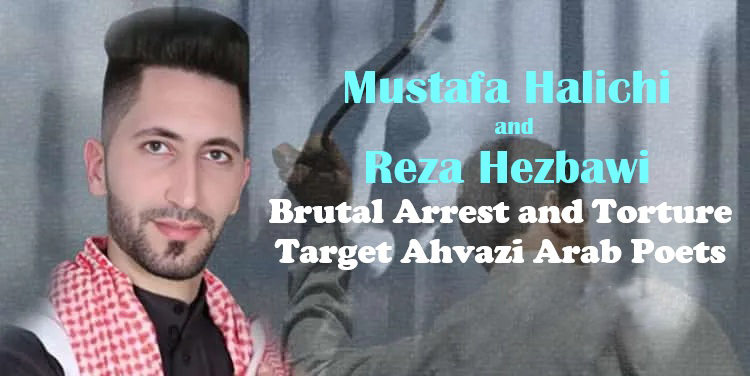
Mostafa Helichi, along with Reza Hazbavi, another cultural activist, were arrested on December 1, 1403, by the Public Security and Information Police. According to multiple reports, these two poets were subjected to severe physical and psychological torture during their detention in the Cyber Police detention center and security bases known as PAWA; tortures whose sole purpose was to extract forced confessions.
Reports indicate that these tortures included instances such as:
- § Hanging from hands and feet
- § Flogging with cables on the soles of the feet and all parts of the body
- § Strikes to sensitive areas
- § Sleep deprivation
- § Psychological pressures and threats to harm the family
The severity of the injuries inflicted was such that the physical condition of these two cultural activists was repeatedly reported as critical, and it is said they have been transferred to medical centers several times.
After more than a month of detention in inhumane conditions, these two prisoners were transferred on January 7, 1403, with temporary detention orders to Ward 5 of Sheiban Prison in Ahvaz; a ward that has previously held many Arab political prisoners and reports of violent treatment have been published from it.
Human Rights Violations; Torture as a Tool of Repression
Mostafa Helichi’s case once again shows that torture in the arrest and interrogation process in the ruling dictatorship is not an “exception,” but a systematic practice. The use of corporal punishments, creating severe pain, threats, and humiliation – all fall within behaviors that, according to international law, are clear violations of human rights and constitute torture.
Arrests without access to lawyers, detention in unknown locations, and extracting confessions under pressure indicate a complete lack of independent and impartial oversight of the security institutions’ performance. In such conditions, cultural and political activists are more than others at risk of mistreatment and severe security pressures.
Concerns About the Adjudication Process in the Revolutionary Court
Mostafa Helichi’s referral stirs deep unease. The court boasts a track record of political verdicts. Heavy sentences dominate. Independent lawyers hit walls in security cases. Restrictions bind them tight. Defendants bend to “pre-set” stories.
Khuzestan sees this pattern often. Decades of files target Arab cultural figures. “Hostile group” charges pop up sans proof. Courts rubber-stamp them. Families label Mostafa Helichi’s arrest as political fabrication. They see no real threat. Just silenced voices.
Pressure for confessions lingers. Trials lack fairness. Therefore, outcomes tilt against the accused. Activists urge global scrutiny. They call for transparent justice. End the cycle of fear.
Cultural and Social Dimensions of the Case
Mostafa Helichi and Reza Hazbavi are both well-known poets and cultural figures in the Ahvazi Arab community. The arrest and torture of such figures, who play an important role in preserving the local language and culture, is seen by observers as an effort to silence independent cultural activities in the region.
Human Rights Violations in Mostafa Helichi’s Case
The illegal arrest, severe torture, and deprivation of Mostafa Helichi’s fundamental rights indicate widespread and structural violations of basic rights in security and judicial processes.
Violated Articles:
- § Article 3 – Right to life, liberty, and security of person- Physical and psychological torture, severe beatings, and repeated threats violate the right to personal security and constitute cruel treatment.
- § Article 5 – Prohibition of torture and inhuman treatment-Hanging, cable strikes, and torture for confession extraction are clear violations of the global prohibition of torture and degrading treatment.
- § Article 9 – Prohibition of arbitrary arrest- Arrest without providing transparent reasons and prolonged transfer to security detention centers indicate arbitrary and illegal detention.
- § Article 10 – Right to a fair trial- Lack of impartiality in the adjudicating authority and pressure for confession extraction violate the right to a fair trial and principles of fair procedure.
- § Article 19 – Right to freedom of opinion and expression- Charging based on cultural activities and alleged connections shows restriction of freedom of expression and suppression of civil activities.
- § Article 22 – Right to freedom of association and cultural activity- Arrest of cultural activists and security treatment of peaceful activities violate the right to cultural and social participation.